Brokers risk wasting millions on unnecessary platform redevelopment, locking themselves into proprietary technology ecosystems and falling behind more agile competitors.
That is the warning from Stepan Bolshakov, Managing Director at dxFeed, the global provider of market data and financial technology solutions. He argues that many firms are relying on outdated approaches to introducing new trading capabilities when targeted technology investments could deliver the functionality customers demand without the cost, disruption and risk of replacing an entire platform.
In a new market analysis, Why Adding Scripting Shouldn’t Mean Replacing Your Trading Platform, Bolshakov challenges the traditional build-or-buy dilemma facing trading firms. He identifies three pillars of a more commercially sustainable approach: reducing platform dependency, strengthening product differentiation and adopting modular technology architectures that allow businesses to introduce new capabilities without replacing established systems.
At the center of the problem is the way advanced trading functionality has traditionally been delivered. Scripting tools, which allow traders to develop custom indicators, test strategies and personalize analytics, are frequently tied to proprietary trading platforms. This can leave brokers facing a choice between expensive internal development and adopting a wider technology ecosystem simply to access a single capability.
The commercial consequences extend beyond development costs. As traders demand greater flexibility and more sophisticated tools, brokers must respond quickly to protect customer engagement and differentiate their offerings. However, technology architectures that require extensive redevelopment for each new capability can slow product development, increase operational complexity and potentially weaken competitiveness.
Bolshakov argues that the solution lies in moving away from monolithic technology models toward modular architectures in which individual capabilities can be integrated independently. Such an approach would allow brokers to retain their existing platforms, preserve established customer experiences and introduce new functionality according to commercial priorities rather than the limitations of proprietary ecosystems.
“Across financial technology, businesses increasingly want the flexibility to choose individual capabilities rather than replace an entire technology stack every time they need new functionality,” Bolshakov explains.
This shift could have significant implications for how brokers allocate technology budgets and evaluate future investments. Rather than treating platform replacement as the default route to modernization, firms can focus on adding specific capabilities that improve the trading experience while protecting the value of their existing infrastructure.
Bolshakov also offers an alternative to the traditional build-or-buy dilemma: “Instead of asking which platform a business needs to move to in order to offer scripting, it can consider how to introduce that functionality into the platform it already operates.”
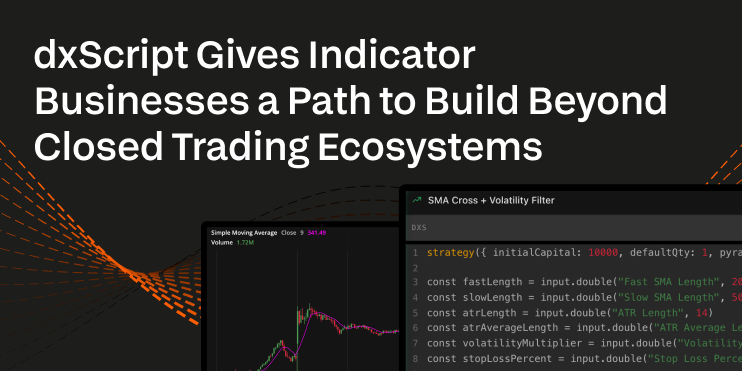
dxFeed is addressing this challenge through dxScript, a modular scripting solution designed to integrate with existing trading environments without requiring a complete platform replacement.
Using HTTP and WebSocket APIs, dxScript enables brokers and trading technology providers to incorporate custom indicators, strategy backtesting and interactive chart functionality into their existing applications. Its modular architecture supports real-time indicator updates while allowing firms to retain control over their established infrastructure, branding, workflows and customer experience.
For brokers, this represents an alternative to costly internal development or wholesale platform migration. By introducing scripting as an independent technology capability, firms can expand their offerings, respond to changing customer expectations and protect existing technology investments without rebuilding the platforms on which their businesses depend.
Read the full market analysis: Why Adding Scripting Shouldn’t Mean Replacing Your Trading Platform.
About dxFeed
dxFeed is a leading market data and financial services provider for the global capital markets, named Best Data Provider by the Fund Intelligence Operations and Services Awards. The company delivers high-quality financial data and services to brokerages, prop traders, exchanges, professional traders, and academic institutions. dxFeed is focused on enhancing AI- and IaaS-driven solutions, while reinforcing its commitment to reliable service provision, compliance and best support. Its technology portfolio includes dxScript, an AI-powered JavaScript-based scripting environment for building custom market analytics and indicators using natural language.
Media inquiries: Paul Lyon, Managing Director, Auster Communications: paul.lyon@austercommunications.com.
Related news: