Trading platforms are becoming increasingly sophisticated, yet introducing a single new capability can still require a disproportionately large technology investment. That’s according to Stepan Bolshakov, Managing Director at dxFeed, who argues that scripting should be treated as an independent technology capability rather than a feature tied to a particular trading platform.
For brokers and trading technology providers, the ability to introduce new capabilities quickly can be critical to retaining customers, differentiating their products, and protecting market position. The challenge is doing so without taking on unnecessary development costs or replacing technology that already works.
Scripting is a clear example. It has become an essential part of modern trading platforms, allowing traders to move beyond standard functionality, create custom indicators, automate strategies, test ideas, and adapt their trading environment to the way they actually work.
The problem, however, lies in how scripting has traditionally been delivered.
In most trading ecosystems, the scripting language belongs to the platform. It is one capability within a much larger technology stack that includes the trading terminal, charting, execution, market data, analytics, user interface, and infrastructure. Many established platforms follow this model: their scripting capabilities may be powerful, but they are designed to operate within their respective ecosystems.
That works well when a business needs an entirely new trading platform. It is a far less attractive commercial proposition when the business already has a platform, established workflows, and a customer experience in which it has invested.
The build or buy dilemma
Consider a broker, FinTech company, or trading platform provider that has spent years developing its own product. It already has the user experience, workflows, integrations, market data infrastructure, charting, and technology its customers know.
Now its users want more flexibility. They want to build proprietary indicators, experiment with trading ideas, customize analytics, or develop their own strategies. The company essentially faces a choice: build a scripting environment internally or adopt a technology ecosystem in which scripting is already included.
The first option requires significant development resources and ongoing maintenance. The second can mean replacing or substantially restructuring technology that is already working.
But what if the company does not need another trading platform? What if it simply needs scripting? This is the architectural question behind dxScript.
From monolithic platforms to modular technology
Across financial technology, businesses increasingly want the flexibility to choose individual capabilities rather than replace an entire technology stack every time they need new functionality.
Market data can be integrated independently. Charting can be added as a component. Analytics can be delivered through APIs. Widgets and other functionality can be embedded into existing products.
Scripting can follow the same model. The continued expansion of dxFeed’s capabilities is part of a broader strategy to deliver market analysis as a service, supporting the industry’s shift toward more modular trading platform architectures. Rather than relying on monolithic technology ecosystems, businesses can access and integrate individual analytical capabilities as their needs evolve.
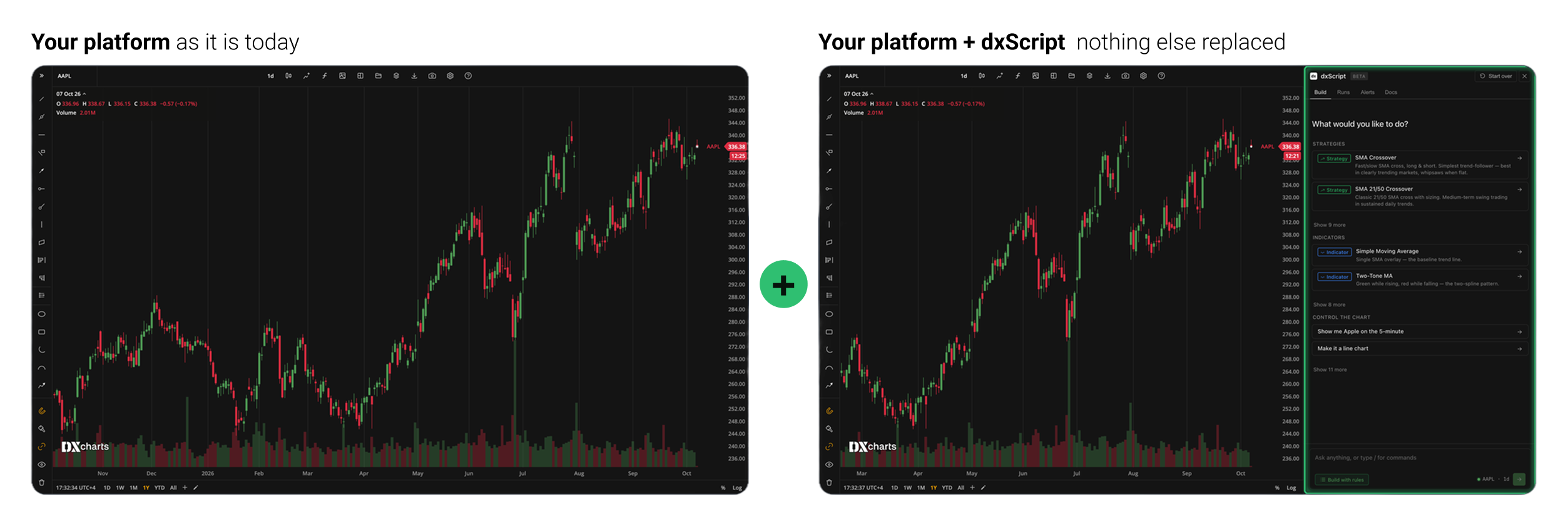
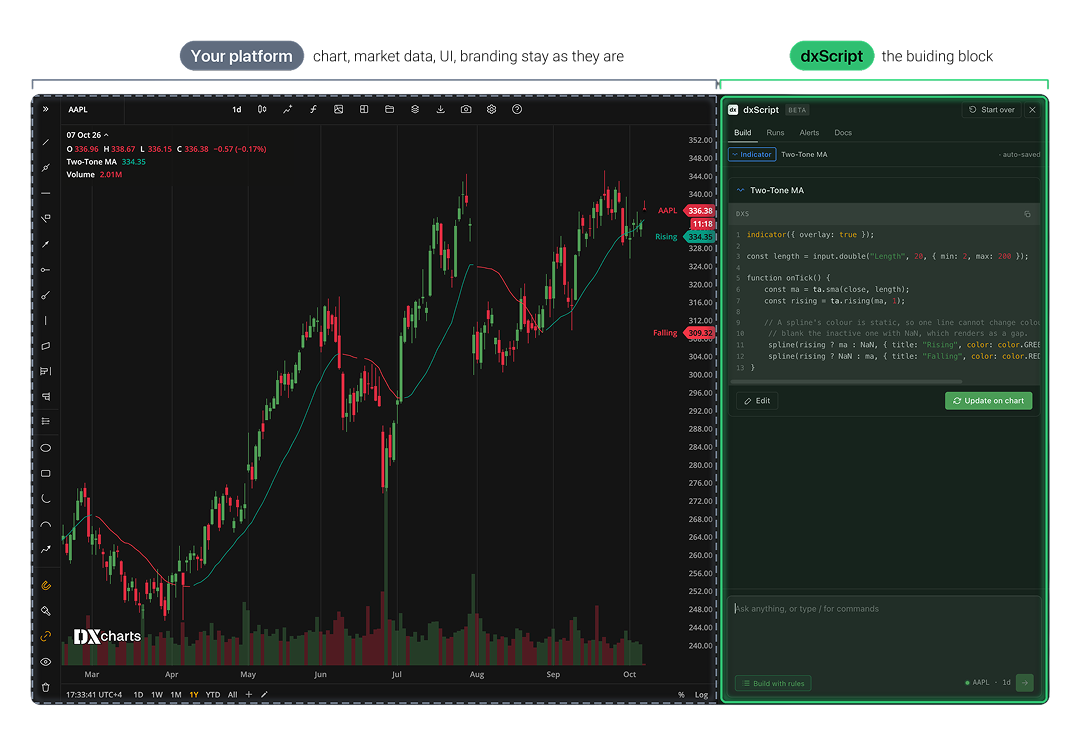
dxScript was designed as a modular building block that can be integrated into an existing trading environment rather than requiring a business to adopt an entirely new platform.
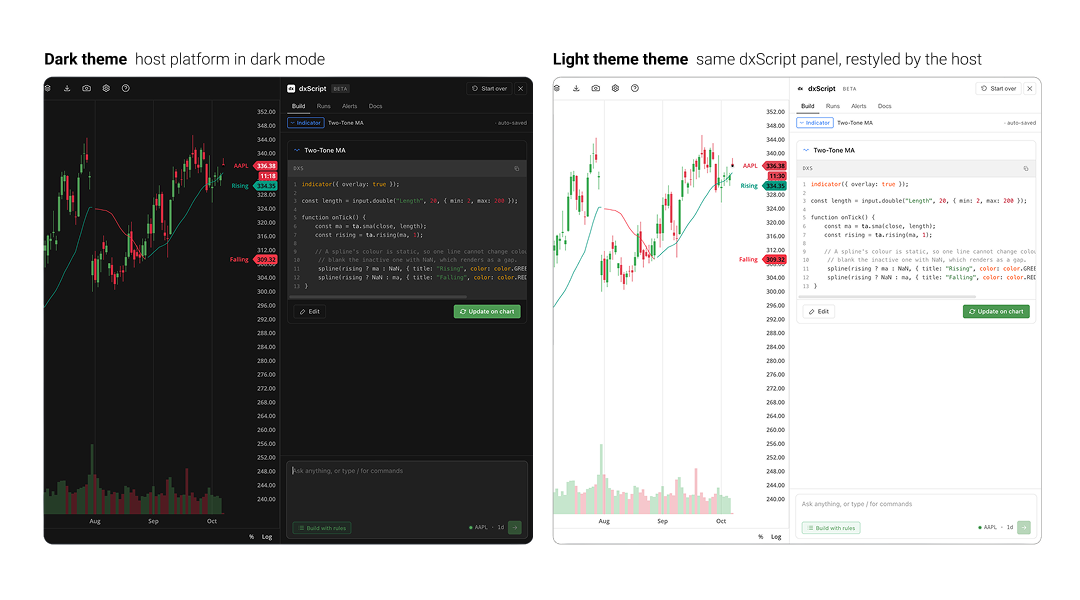
For companies with established platforms, this offers a different approach. They can add scripting functionality while preserving the technology, interface, workflows, branding, and customer experience they have already built.
dxScript integrates with existing trading environments through HTTP and WebSocket APIs, allowing businesses to incorporate scripting capabilities into their own platforms without replacing the underlying infrastructure. Its modular services support script validation, strategy backtesting, and interactive chart integration, with WebSocket connections enabling real-time indicator updates. This allows brokers and platform providers to introduce custom scripting functionality within their existing applications while retaining control over the user experience and broader technology stack.
Importantly, the benefits extend beyond technology architecture. A modular approach can help businesses protect existing investments, introduce new functionality more efficiently, and retain greater control over how their platforms evolve.
Add the capability, keep the platform
This changes the technology decision from a platform replacement question into a capability question.
Instead of asking which platform a business needs to move to in order to offer scripting, it can consider how to introduce that functionality into the platform it already operates.
With dxScript, scripting becomes another component within the product. Businesses can give their users the ability to create custom indicators and trading strategies without rebuilding the rest of their trading environment around the scripting technology.
This modular approach also gives businesses more control over how the capability fits into their product. Rather than adopting a predefined trading experience, they can incorporate scripting into the experience they already provide.
For brokers and platform providers, that flexibility can support product differentiation while reducing the need for unnecessary redevelopment. It also offers greater freedom to select technology according to commercial requirements rather than the constraints of a single platform ecosystem.
The commercial opportunity is significant. According to industry estimates, around 16.5% of brokerage users are interested in scripting capabilities, while traders who use scripting show approximately 20% higher trading frequency. For brokers, this points to a compelling business opportunity: enabling customers to develop their own indicators and strategies can support greater trading engagement and potentially generate additional transaction-based revenue, without requiring a complete platform overhaul.
Scripting as a building block
This shift may become increasingly important as trading platforms differentiate themselves through customization.
Traders expect greater control over how they analyze markets and translate ideas into tools. At the same time, brokers and FinTech companies want to provide that flexibility without turning every new capability into a major platform-development project.
Treating scripting as a standalone element addresses both sides of that equation.
The larger change is architectural. Scripting does not have to be a feature that is available only as part of someone else’s trading ecosystem. It can be a modular component, added where it is needed while the rest of the platform remains in place.
For businesses that have already invested in building their own trading experience, that is a fundamentally different proposition.

Related articles: